Category: Leadership

  • 5 Steps to Becoming a Better Leader

    I was driving home with my wife from visiting our 5 month old granddaughter. By the way, she is really cute. My cell phone rang and this pleasant voice on the other end called me by name and says who she is. Since I get a lot of calls from people and I do not know who they are, they may be clients or potential clients, I try to listen and interact enthusiastically. The lady’s name was Karen. As I said Karen called me by name. But, I did not recognize the voice. She could have gotten my name off my web site. Or it could be I knew her and simply had not recognized the voice yet. Karen then told me I was going to receive a free quote on some health insurance so I could compare costs. As politely as I could I informed Karen that I was not interested in switching insurance carriers and thanked her for her call. I really was not thankful for the call. I was just trying to be polite.

    As I mentioned the call came in while I was driving and as a result it went over blue tooth in my cars to my car speakers. That meant my wife, Patricia, heard both sides of the conversation. Now, my wife is not a sales person. She is very introverted and never likes being brought into the spot light. That’s a lesson I keep have to relearn. Her only involvement in sales is a purchaser. And as a purchaser she had some very interesting insight as to the sales process. After I hung up, she said, “I think sale peoples tactics are going to have to change.” I agree with her. Of course, I’ve found when I don’t, I am usually wrong. I mean that sincerely. Her insights are pretty accurate.

    Let’s look at what happened when Karen called.

    When Karen’s called she had my attention. I thought she might be a potential client or past client whom I did not recognize. However, Karen never gave me a reason to be interested in her or her product. She only said she was going to send me a price list so I could compare prices. She never established the fact I needed or even wanted her product. Consequently, I didn’t want it. The only thing she did was to allow me seeing myself taking time out of my busy day to accomplish a task that would only benefit her. Comparing prices!? That’s an activity which may or may not provide me any benefit. In fact, my belief that all reputable providers are going to be pretty close to the same price causes me to not believe I will receive any benefit at all. It’s only cost me.

    Persuading someone to do something you need to have done is real leadership. Every executive, manager and salesperson, mother or for that matter everyone has to answer the question, “How can I convince someone else to do something I need to have done.” Mothers have to convince little Johnny to clean up his room. Sales people are trying to convince a buyer to purchase their product. Managers try to convince employees to accomplish a task within a designated period of time. Employees try to convince their manager they need more resources. Everyone needs to persuade someone else about something.

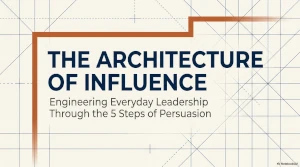
    Fortunately there is a proven successful 5 step approach. It was developed in the 1930’s by Alan Monroe. Dr. Monroe was a professor at Purdue in the 1930s. Monroe created what is known as the Monroe Motivated Sequence. The sequence is a logical progression of steps to motivate someone to take action.

    These steps may seem a little trite to you. You’ve seen at work so many times in so many places. You’ve seen them used in everything from infomercials to presidential elections. Why? Because, they work. Here they are:

    1. Attention – You need to grab and hold the attention of your audience. Use a story, shocking example, dramatic statistic, and quotations, something that will capture the imagination.
    2. Need – Show that the problem is real. The problem is truly significant, and it is not going to go away by itself. Use statistics and examples. In this step, you’re convincing your audience that there’s a need to take action.
    3. Satisfy – Now you need to provide a solution to the problem you have just outlined. Be specific and give solutions that can implement. And once implement, the problem will either be solved or improved.
    4. Visualization – Tell the audience what will happen if the solution is implemented. Draw word pictures let them actually see in their mind the result.
    5. Action – Tell the audience what specific action they can take personally. No this is not obvious. Without this step the conclusion your audience will draw will be, “Yeah, that’s a great idea. Somebody should do that.” You want them to be that somebody, so tell them what they can do.The next time you need to give a presentation, write an article or make a sales call or convince little Johnny to clean his room. Think about what you are going to say. Think about the other person. How do they understand their needs? How does your proposal or product satisfy that need? If they see how they benefit they will be a willing participant in you proposition.

    Learn the steps in the Monroe Motivate Sequence and put them into action. If you do you will be a better persuader which means you will be a better leader.

  • Remember a Long List of Items

    Having a good memory is an important skill in business. Notice I referred to memory as a skill not simply as an ability. Being able to recall lists of items quickly, accurately and reliably improves both your productivity and creativity. Often we are left with the impression that some people are simply blessed have a good memory and while others or not. For example, my wife has a great memory. And I always had difficulty remembering things, anything. The problem was, I had never been taught how to remember. I had never been shown how to develop the memory skill. When I asked Patricia, my wife, how she was able to remember so many items, she told me. She said she simply has a picture in her head. The process she used was completely foreign to me. I simply assumed that you either had it or you did not. I really did not understand what she was saying. But having done a lot of research on the mind and memory, I now have a better understanding of how to remember details. Today, I demonstrate my mental skills in my mentalism show by learning a list of 20 random items is a few seconds. I memorize a current popular magazine. Then have someone randomly turns to a page and I can tell them what is on that page. The average person today can only remember a list of 3 to 4 items. And that is actually down from 7 items only 40 years.

    How do I do it? How do I memorize so much in such a short period of time? Well it has been through years of rigorous training and sacrifice, through deep mediation and careful study, I have been able to develop my mental powers to into something only few can achieve. Ok, that is not true. I use a technique that only takes a few minutes to learn. And as with any skill, the more you practice the better you become.

    Here is how I do it. I use what are called memory pegs and memory associations. I first memorize a list of words. This list never changes. Then I make an association between the items I am trying to remember with an items in the list I have already learned. There are several peg lists you can use. I use different lists based on the type of things I am trying to remember.

    Yesterday, I was out and stopped by the grocery store. As I pulled into the parking lot, I called my wife to ask her if there was anything she would like me to pick up. She raddled of several items. I did not have a pen to write them down plus I was looking for a parking place at the time. So here is real life example on how the process works.

    Here is a peg list I am sure you already know.

    1. Thumb
    2. Shoe
    3. Knee
    4. Door
    5. Hive
    6. Sticks
    7. Heaven
    8. Gate
    9. Spine
    10. Hen

    In case you do not recognize it, this list is from the children’s song “This Old Man” It goes: “This old man he played one. He played nick knack on my thumb. With a nick knack paddy whack throw the dog a bone. This old man came rolling home.” and so on. The list is easy to remember because all the items rhythm with the number they are associated with. So let’s give the process a try.

    Here is a grocery list or 10 random items

    1. Milk
    2. Potato Chips
    3. Bread
    4. Lunch Meat
    5. Eggs
    6. Bell Peppers
    7. Onion
    8. Ketchup
    9. Cheese
    10. Nuts

    Now associate each item in the grocery list with the corresponding item in the list from the song “This Old Man” The grocery list # 1 item is milk and the #1 item in the “This Old Man” list is thumb. You could imagine yourself making a fist with your thumb sticking straight up in the air then as you squeeze your fist milk spurts out your thumb. And adding detail to the mental imagine makes it more memorable. So instead of just milk this is 1% white milk as opposed to 2% or chocolate. Now think about little 1 shaped capsules filled with white milk popping out of your thumb as you squeeze your fist. Boop! Boop! Boop! The more ridiculous the image the easier it is to remember. What that means is remembering details about an item should now be easier. Now, instead if milk coming out of your thumb when you squeezed your fist, you could imagine a baby sucking on a thumb and milk coming out of the thumb as the baby sucked. But that almost makes sense. Well, in my world it makes sense. Anyway generally the more ridiculous the image is, the easier it is to remember. But you can obviously customize this to your own personality.

    Let’s do one more together. The second item on the grocery list is Potato Chips. The #2 item in the “This Old Man” song is shoe. You can imagine wearing a bag of potato chips on your feet as shoes. And as you step, the potato chip bag shoes make loud crunching sounds.

    Go through the grocery list using this process with every item on the list. And you will be able to remember 10 random items. Plus you will be able to recall them randomly so that if you are asked, “What is item #6,” you will remember the peg word or image for 6 is stick. Then you will see a small boy with a stick playing a song by hitting the peppers with a stick. Why a song? Well because these are bell peppers and they ring every time the boy hits one with his stick. You just got a peek inside how my mind works. I know it is a little scary but I bet you can use this technique to remember long list of items as well.

    Remember the average person today can only remember a list of 3 to 4 items. You know how to remember 10 items. You are already well above average. Your productivity and therefore your value will increase as well.

    If you are interested in having me help improve the productivity and creativity of your team, or demonstrate amazing feats of memory. Send me an email at contact @ jd-stewart.com.

  • How Sales Contests Destroy Your Sales Staff

    Sales contests are often used to motivate sales people. It is assumed sales people are naturally competitive. Therefore, giving them an opportunity to compete amongst themselves will be fun and improve both morale and productivity. In actuality it has the reverse effect. There may be a temporary boost in productivity. But there is a long term loss of both morale and productivity.

    With most sales contests there are winners and losers. The winners tend to look down on the losers because they are losers. And the losers are jealous of the winners. The result is a division within the sales team. Animosity is created between team members. In addition, the winners generally tend to be the same set of winners. Therefore the losers tend to be the same set of losers. The result is poor morale within the team which causes reduced productivity. If only one person can win then the others, even though they are good sales people, resent the winners. They would have won but the contest was rigged or, if only the timing were different, or the winner just got lucky, or the winner had been in their territory longer, or the engineering staff had sent Jim rather than Joe for sales support, or any of a thousand other things. In addition, the sales team learns not to share with one another or help each other because they want to win next time. The thinking goes, “Why would I want to help my competition?” This type of sales contest creates dysfunctional teams.

    Some sales managers realize this and therefore create contests where winning the contest does not automatically create losers. The contest is won by achieving a specified goal or sales level. Anyone who reaches a specified level wins the prize. That is theoretically better but in actuality, unless everyone reaches the specified level you still have winners and losers. Winners tend to look down on the losers and the losers are jealous of the winners. And the sales staff is still competing with each other.

    I know of several sales managers who either think this is fine or do not care. Their thinking is like this, “I don’t want a bunch of losers on my team, anyway. If they can’t hack, too bad. I hope they quit so I can hire some winners.” The problem is they do not quit. They are just de-motivated. And besides that there are many more average sales people than super stars. So the probability is the sales manager will hire another average sales person and loose additional productivity while they are learning the ropes.

    I am not against competition. I think competition is great. I believe that, not only is competition a good thing, it is vital to any business. You just need to be sure you are competing against a true opponent not an artificial one. So ask this question, what is the purpose of a sales contest? Why have a sales contest at all? The ultimate goal is to have a motivated sales staff that consistently improves sales revenue. A sales contest with winners and losers fulfils none of those goals. You may motivate a few sales people. You may have a temporary boost in sales numbers. But the team has not improved. And if the sales numbers improve, they are not sustainable.

    Would it not be better to have the entire sales staff improve their sales revenue? Would it not be better to have the hot shot sales person motivated to share his tricks of the trade with those who are struggling?

    Instead of creating individual rewards. Create team rewards, a common cause if you will. The individual wins only if the team wins. If everyone is working for the same goal then they work together. The stronger help the weaker become stronger. The result is an over all stronger team. The skills developed during the contest are now sustainable. The team has long term improvement. Rather than individuals working against each other. Everyone’s goals are now aligned with not only with the sales manager but with the business as a whole.

  • The Law of Leadership

    If you are like most business people you believe that in order to succeed, you have to convince your prospects that you offer a better service, or product. In other words you are competing in a me-too world. You are offering the same thing only your’s is better.

    But if you really want to be successful offering a better product than your competitors does, is simply going about it the wrong way. Your prospects need to think of you, not simply as one of many, but in a class all by yourself. You have to be in a category where you are first. Simply being first, will usually make you number 1. The truth is, it is better to be first than to be better. Innovation will make you number 1. If all you are doing is implementing someone else’s idea, you have an up hill climb. Because no one remembers number 2.

    Here is a quick example. Who was the first person to fly across the Atlantic Ocean? Charles Lindbergh. Now, who was the second person to fly across the Atlantic Ocean? That one is a little harder. It was Bert Hinkler. Hinkler was the better pilot. He made the crossing in less time and expended less fuel. But no one remembers Bert Hinkler. Being better did not make him number 1. It only made him another one.

    The law of leadership applies to any product, any service any brand. Do you know the name of the first College in America. You can substitute the most well know and make a good guess. Most people would say Harvard, which is also the name of the first College in America. Do you know the name of the second College in America? William and Mary, which is only slightly better known than Bert Hinkler.

    Which came first Coca-Cola or Pepsi-Cola. Coca-Cola was the first and is still the leader in the cola wars.

    Growing up almost every soft drink was a coke. The only question was did you want a grape coke or an orange coke. Everything was a Coke because Coca-Cola was the first. In fact it wasn’t until the last few years that I stopped calling all soda pop cokes. But I still call all cola’s Cokes. I don’t care if it is a Pepsi, a RC or the generic anything else it is a Coke. Coke has become the generic name for all colas.

    My mother claims Pepsi-Cola is the superior product. Even if that is true (a point we disagree upon) Coke was first and remains the leader.

    In spite of all the evidence to the contrary businesses continue to try to be a better followers than innovators. The leading brand in any category is almost always the first. People tend to stick with what they’ve got. You don’t change spouses simply because you come across someone a little better. (Thank goodness or my wife would have left me long ago.) It is just easier to stay with the familiar. The law of leadership applies to everything. Chrysler was the first to come out with the mini-van. Almost every manufacturer of automobiles make min vans. Yet over half of all minivans sold in the United States are built by Chrysler.

    One reason the first brand tends to maintain it leadership is the name often becomes generic. I make a Xerox copy. I do not make a Sharp or a Kodak copy. People ask for Scotch Tape not cellophane tape, a Kleenex not a facial tissue, a Band-aid rather than a … Well I don’t know what the generic of a band aid would even be.

    If you think simply being better will take you to the top, you are ignoring both history and human nature. Innovation is the fastest and quickest way to succeed. You can not lead by following.

  • Dealing with Unfair Criticism

    Responding calmly and rationally to unwarranted criticism


    Recently I was leading a discussion over how to teach fairly some complicated concepts. When all of a sudden the individual on my left burst out in anger with accusations about my motives which were completely untrue. All eyes were on me. What would I say? How would I react? I am proud to say I followed the step below and came out of the assault unscathed.

    You may have experienced something similar. Maybe you gave a presentation at work, outlining a new marketing plan, or an idea for a new product. You think all is going well when one of the participants delivers a scathing critique. Each point you believe is either completely incorrect or a simple misunderstanding of your position. Everyone one now looking at you. What will you say? How will you react?

    How you react in these situations have a tremendous impact on your career and relationships not only with the one who has attacked you but, if there are witnesses, every one who witnesses the attack and everyone who hear about the exchange.

    When you are unjustly criticized emotions run high and therefore it is not the best idea to trust your instincts. Your initial reaction has the largest impact on how things will turn out. It alone has the ability to make things better or worse. Here is my recommendation on how to fight against the urge to strike out.

    1: Remain calm
    The most important thing to do is remain calm. Remaining calm and respectful, particularly if the other party does not, will help defuse the situation and can even rally support. Give the impression of taking the comments thoughtfully and respectfully. Even if they are blatantly false. Ask why does this person thinks you are such and such or you have done such and such. Regardless of how off base and vicious the attack, the attacker believes they are justified in the attack. Try to find out why?

    When we receive negative criticism anger or feelings of inadequacy well up in us. If we expressing these emotions we only dig ourselves a deeper into a hole from which we may not be able to crawl. Have your response be courtesy and take the higher ground. So just pause, taking couple of deep, quiet breaths through your nose will help calm you down.

    2: Asked to have the point repeated or clarified
    Give yourself some time to think. You do not have to develop a response on the spot. One way to get some time is simply to calmly repeat the criticism back to the individual in your own words. And then ask if you understand correctly. Make eye contact and in a non-aggressive non-threatening tone, say: “So, if I understand your correctly you’re saying…,” and put his criticisms in your words. The goal is to take the focus off of personalities, and place it on the issue at hand.

    When you put the criticism in your own words, do so accurately, do not over state you case. Simply reword the point to the best of your ability. If he claims your proposal will not bring the results you are claiming. Do not say “So what you are saying is this will destroy the company.” Exaggerating the criticism will make you appear defensive and looking for a fight – rather than being the cool, calm and rational one.

    If you do not understand the point or can not make the connects your assailant is making. Simply asking for more information can help A simple question,”Can you tell me more,” works wonders. If what is being said is truly ridiculous. He may sudden realize he is in an untenable situation.

    The goal is to take the focus off of you and your reaction and put it on the his criticisms.

    3: Examine both perspectives
    The goal is not to have either one of you leave bloody and beaten the goal is to identify and address the issue. So once you have taken the focus off of the personalities place the focus squarely on the issue at hand. This is a good time to open a real discussion of the critique. Depending on the situation you can start off with phrases like: “I can see how you might get that idea, I probably haven’t properly explained that;” “I understand what you are saying and that is why…;” “That an interesting perspective. I understand how you feel.” The idea is to establish a rapport  and showing respect is key even if you have not been shown any. Once you have demonstrated respect give him the opportunity to return the favor.

    4: Politely Move on
    Even in the best of worlds with the best of tactics, things do not always work out like we would like to have them work out. You can have executed the first three steps flawlessly and you are at an impasse. You have remained calm and demonstrated respect, as you reworded the criticism in your own words. You have calmly and without shame shown you understand their perspective. Even after all this your critic holds firm. This is time for a graceful exit. You can say some thing like: “That’s certainly something to think about going forward;” “I appreciate the feedback;” “We definitely aught to consider that in the next version.” You have just positioned yourself as someone who is genuinely trying to do the best job possible. It also places the focus on the future actions and allow you to move on.